Reliable spatial perception needs two things at once: recognizing what is where, and pinning down where exactly, in metric 3D. Learned and foundation models handle the recognition well but stay geometrically loose, blurring the boundaries and discontinuities where 3D structure lives and losing absolute scale. I build the geometric half of this picture and inject it into learned and semantic models, so the recovered 3D becomes metric and structurally consistent.
The constant across my work is not a tool but a principle: identify the geometric relation a representation gets wrong, then supply the explicit cue the problem demands. For one problem that cue is a surface-normal field, for another a sharp-feature descriptor, for another a ground plane. Each project surfaced its own geometric bottleneck, and I built the module that resolved it.
I am extending this toward image-grounded, semantic foundation models: supplying the geometric half they lack so their rich but up-to-scale output becomes metric, consistent, and structured. My aim is spatial perception in which explicit geometry is a first-class inductive bias, fused with learned recognition rather than left for it to infer.
One-paragraph bio for talks & committees
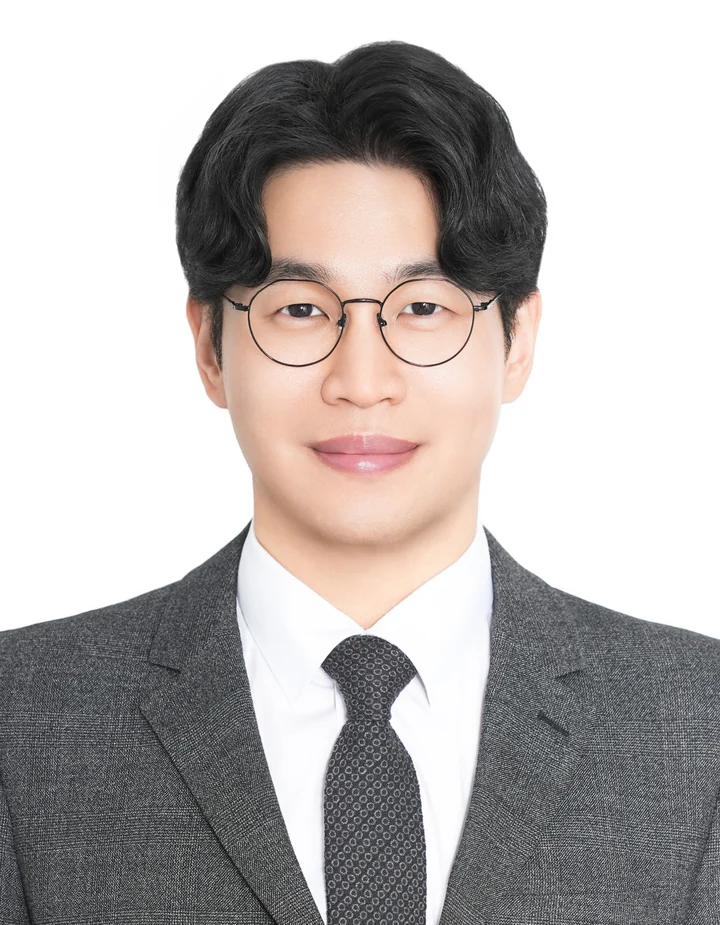
Inyoung Oh is a postdoctoral fellow in the Center for Artificial Intelligence at the Korea Institute of Science and Technology (KIST). Oh received a Ph.D. in Mechanical and Robotics Engineering from the Gwangju Institute of Science and Technology (GIST) in 2026, advised by Prof. Kwang Hee Ko. Oh's research fuses explicit geometry — surface normals, sharp features, and ground planes — with learned and semantic models so that recovered 3D becomes metric, consistent, and structured, spanning point-cloud analysis (including SFD-Net, ECCV 2026) and metric 3D from monocular video.
Reframed relocalization from a moving camera — placing it and nearby people in metric 3D from RGB alone — as a geometric 2D–3D bridge: on an up-to-scale map, metric placement reduces to a ray–ground intersection governed by one scene-intrinsic quantity, the ground-plane normal.
The resulting estimator is representation-agnostic and substantially outperforms strong monocular-depth and feed-forward reconstruction baselines across indoor and outdoor capture (manuscript in preparation).
This places my doctoral geometry at the crux: the surface normals and sharp/planar discontinuities my descriptors deliver, carried from point clouds into image-grounded 3D.
Research AssistantModeling and Simulation Lab, GIST · Advisor: Prof. Kwang Hee KoFeb 2016 — Feb 2026
Established the geometric half of this fusion: explicit scene-intrinsic cues, injected into learned models, that transfer across sensors, sampling density, and noise.
Sharp features & geometric descriptors
SFD-Net (ECCV 2026): an architecture-agnostic sharp-feature descriptor; prepended unmodified to three independent backbones it raises Average F1 by +4–7 pp and transfers zero-shot from synthetic CAD to real scans ~36× larger.
Grounding the descriptor theoretically via directional statistics, replacing heuristic scale selection with a training-free geometric prior that stays informative precisely at discontinuities (in preparation).
Normal estimation & segmentation
A multi-scale, noise-aware normal estimator with attention-based scale weighting; lowest noise-free RMSE on the PCPNet primitive subset (IJIG 2026).
Intensity-assisted normal cues injected into RandLA-Net (+4.0 pp mIoU on SemanticKITTI, with the largest gains on safety-critical classes), extended to boundary-aware indoor segmentation on S3DIS (+6.3% mIoU over PushBoundary; Ph.D. thesis).
Pose, MR systems & primitive recognition
RoI-PCA color augmentation for markerless 6-DoF RGB pose (+10.77 pp on LINEMOD 5cm5°), deployed in a real-time multi-device MR remote-collaboration system (Computers in Industry, 2026).
Prior-free pipeline recognition from unorganized point clouds: curvature-driven classification and sphere-RANSAC centerline recovery without user-specified priors (The Visual Computer, 2021; registered patent with technology transfer).
Education
Degrees
Ph.D., Mechanical & Robotics Engineering2018 — Feb 2026
GIST · Advisor: Prof. Kwang Hee Ko · GPA 4.2/4.5
Dissertation: Normal Vector Estimation, and Semantic Segmentation of 3D Point Clouds using Deep Learning and Geometric Analysis
M.S., Mechatronics2016 — 2018
GIST · Advisor: Prof. Kwang Hee Ko · GPA 3.91/4.5
Thesis: Sphere and Cylinder Detection in Kinect Point Clouds using RANSAC and the 2D Hough Transform
B.S., Mechatronics Engineering2009 — 2016
Chungnam National University · GPA 3.91/4.5
Thesis: Research on Semi-Automatic Drills — Grand Prize, Capstone Design Fair
Recognition
Awards & scholarships
Best Poster Award ×5, Korean Society for Computational Design and Engineering (CDE)
2020 — 2025
CDE DX Encouragement Award, Korean CDE Society
2022
Outstanding Ph.D. Student RA Scholarship ×5, GIST
2018 — 2025
GIST Full Scholarship (government-funded, M.S. & Ph.D.)
2016 — 2026
More
Teaching, service & skills
Teaching & mentorship
Mentorship, MODSIM Lab, GIST (2018–2026): mentored a student from undergraduate intern through graduate studies; mentee published a first-author journal paper (JCDE, 2023). Guided additional interns and supervised a bachelor's thesis.
HYJI — a free, open-source, local-first Windows app for reading and annotating research papers: highlight a sentence and send it into structured notes (summary / differentiation / questions) with bidirectional links back to the source. Built on weekends; MIT-licensed. GitHub.
I used HYJI to annotate the related work while writing SFD-Net.