Twelve seconds, whole paper. Ground-truth sharp features (red) cross-fade into SFD-Net's prediction — green correct, red false alarm, orange missed — while the cloud completes one revolution.
Detection fails where a representation gets the geometry wrong. Find that relation, then supply the explicit cue that fixes it.
Here the relation is the discontinuity of the surface-normal field, and the cue is a small multi-scale descriptor. The descriptor, not any backbone-specific tuning, is what drives the gains, which is why it carries across architectures and from synthetic CAD to real scans.
Abstract
Sharp features are the loci where a surface's normal field is discontinuous: the creases and corners that define an object's structure. They are also where detection breaks down, because joint density variation and noise destabilize the local statistics detection relies on, and because sharp points are a small minority class. SFD-Net addresses this with the Local Geometric Descriptor (LGD): per-point normals estimated at three nested neighborhood scales, aggregated as second-moment statistics of normal differences into a compact, scale-aware isotropy cue. Because it operates on normal differences, LGD is invariant to rigid motion, global scale, and normal sign flips, with no explicit alignment. It prepends to point-cloud backbones without modification: on the ABC benchmark it reaches state-of-the-art F1 across four density-and-noise conditions, improves three independent backbones in a plug-and-play setting, and transfers zero-shot from synthetic CAD to real scans up to ~710× larger.
Transferable
A descriptor, not an architecture
LGD prepends to PointNet++, RepSurf, and EDWG unmodified, adding +4.05 to +7.00 F1 while cutting FPR by 2.62–9.08. The descriptor drives the gains.
State of the art
Leads ABC across every condition
Best F1 in every one of the four density-and-noise settings (61.33 → 57.05), including the largest-noise setting.
By construction
Invariant without alignment
Operating on normal differences makes LGD invariant to rigid motion, global scale, and normal sign flips, with no orientation propagation.
Generalizes
Zero-shot, CAD → real
Trained only on 10K-point CAD, applied directly to real S3DIS scans up to 7.1M points (~710×) with no retraining or subsampling.
Method
The Local Geometric Descriptor
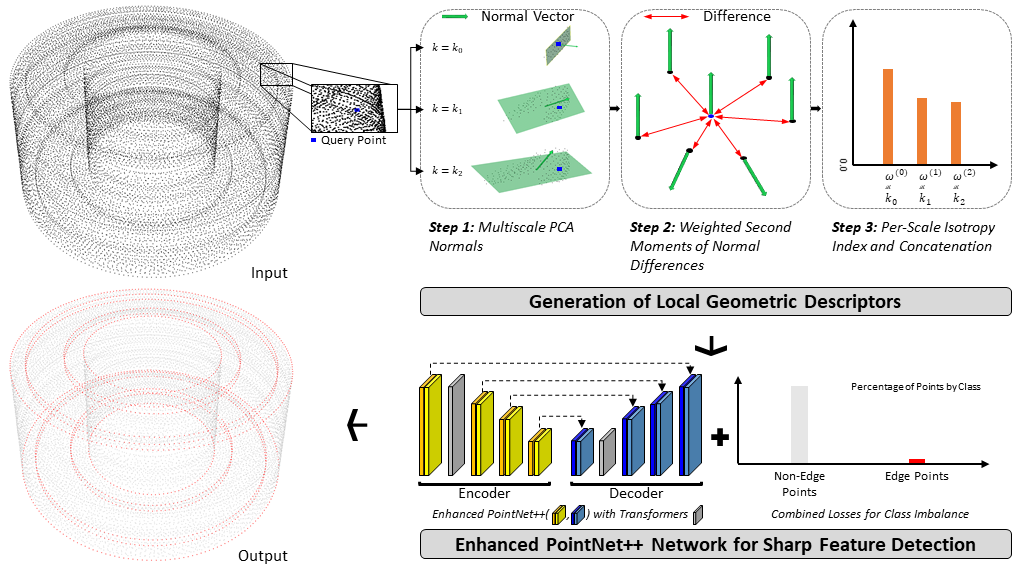
LGD turns each point into a three-value cue, then hands it to a learned backbone. The geometry is made explicit before learning, rather than left for the network to infer from raw coordinates.
Two stages. LGD is computed from multi-scale normal statistics, concatenated with raw coordinates, and fed to an enhanced PointNet++ with two lightweight Transformer blocks and an imbalance-aware loss.The descriptor, live. LGD's combined response on a raw cloud — high (warm) exactly along creases — computed before any network sees the points.
01
Multi-scale PCA normals
Estimate a unit normal at three nested neighborhoods (k = 20, 40, 80). Only directions are kept, giving sign-flip invariance.
02
Second moments of normal differences
Accumulate weighted outer products of normal differences per scale. Using Δn Δn⊤ yields rigid-motion and global-scale invariance with no alignment.
03
Per-scale isotropy index
Collapse each scale to one isotropy value, low on planar patches and high near creases and corners, and concatenate the three into a compact cue.
What LGD is, precisely. It is a precomputed geometric cue that complements a learned backbone, not a replacement for learned features, and the pipeline is not end-to-end differentiable. Because the gains come from the descriptor, it transfers across backbones rather than being tied to one. Replacing the PCA step with a learned estimator is left for future work.
Results
State of the art on ABC
Four conditions: density variation only (none), then increasing Gaussian noise. SFD-Net leads F1 in every condition while keeping FPR among the lowest.
Average F1 ↑ / FPR ↓ on ABC (%). Bold row: ours.
Method
none F1
FPR
0.12% F1
FPR
0.6% F1
FPR
1.2% F1
FPR
PointNet++
50.89
48.57
55.02
45.88
49.03
49.35
50.21
49.01
DGCNN
49.89
48.90
50.65
48.51
48.44
49.58
47.53
49.99
RepSurf
55.23
45.96
57.16
43.06
54.21
46.55
48.17
49.73
PointMLP
54.59
46.30
47.53
50.00
47.52
50.01
47.65
49.94
PIE-Net
52.55
38.50
52.44
37.35
47.61
40.54
49.56
39.33
BoundED
48.12
49.88
47.98
49.94
47.97
49.90
47.70
49.98
SFC-Net
47.92
49.84
48.64
49.53
48.27
49.69
48.03
49.80
MSL-Net
59.41
–
59.11
–
56.11
–
52.74
–
EdgeFormer
52.04
31.24
48.66
33.95
34.99
45.16
28.13
48.55
EDWG
54.95
46.06
54.93
46.07
48.20
49.81
47.76
49.90
SFD-Net (ours)
61.33
36.93
60.42
39.76
58.62
40.88
57.05
41.94
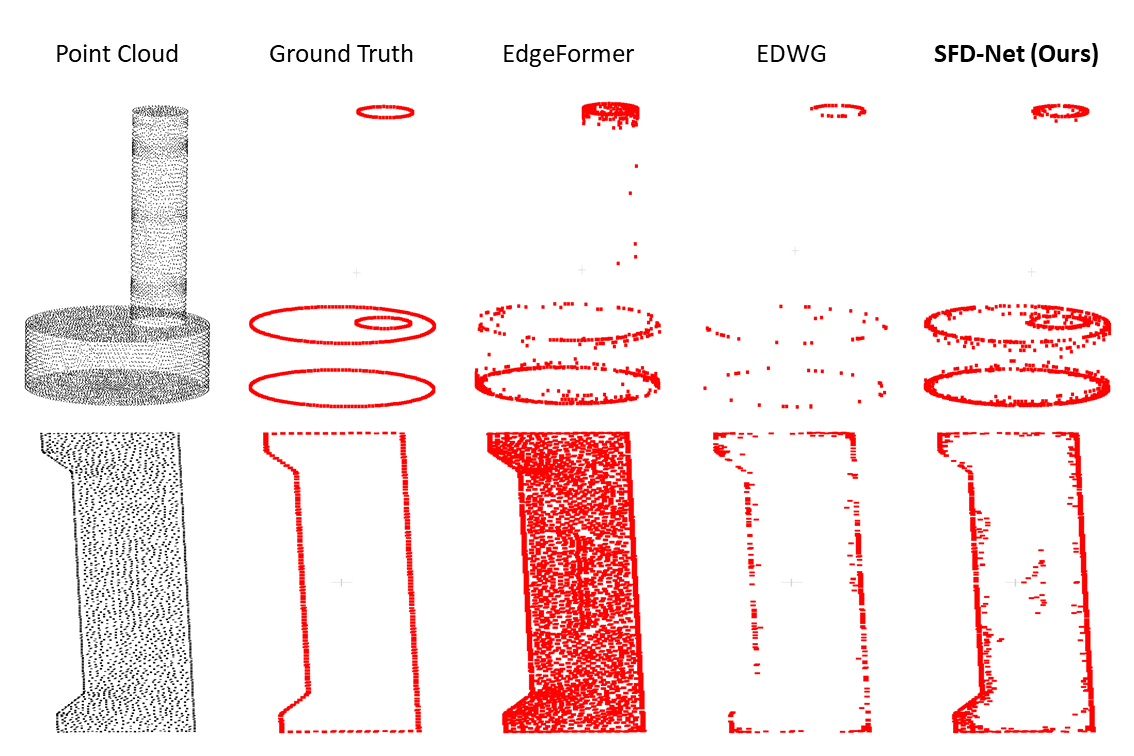
ABC (synthetic CAD). EdgeFormer over-detects on smooth faces and EDWG misses structure, while SFD-Net stays close to ground truth.
Inspect a prediction
Drag the divider. Left is the ground truth; right is SFD-Net's point-wise decision on the same rotating cloud — green correct, red false alarm, orange missed.
↔
Ground truthSFD-Net
Architecture-agnostic
Prepending LGD, with no architectural change, improves all three backbones. LGD + EDWG (60.80 F1) nearly matches full SFD-Net (61.33), confirming the descriptor is the primary driver.
Plug-and-play LGD on ABC (density variation only), %.
Backbone
F1 ↑
FPR ↓
ΔF1
ΔFPR
PointNet++
50.89
48.57
—
—
+ LGD
57.89
43.70
+7.00
−4.87
RepSurf
55.23
45.96
—
—
+ LGD
59.28
43.34
+4.05
−2.62
EDWG
54.95
46.06
—
—
+ LGD
60.80
36.98
+5.85
−9.08
Turn up the noise
Slide from clean to 1.2% Gaussian noise. The camera never moves; only the corruption does — and the detected creases stay put. Across the full 510-model test set, Average F1 goes 61.33 → 57.05.
noise: none
none0.12%0.6%1.2%
Zero-shot transfer to real scans
Trained only on 10K-point synthetic CAD, SFD-Net is applied directly to real S3DIS scenes (363K to 7.1M points) with no retraining, fine-tuning, or subsampling.
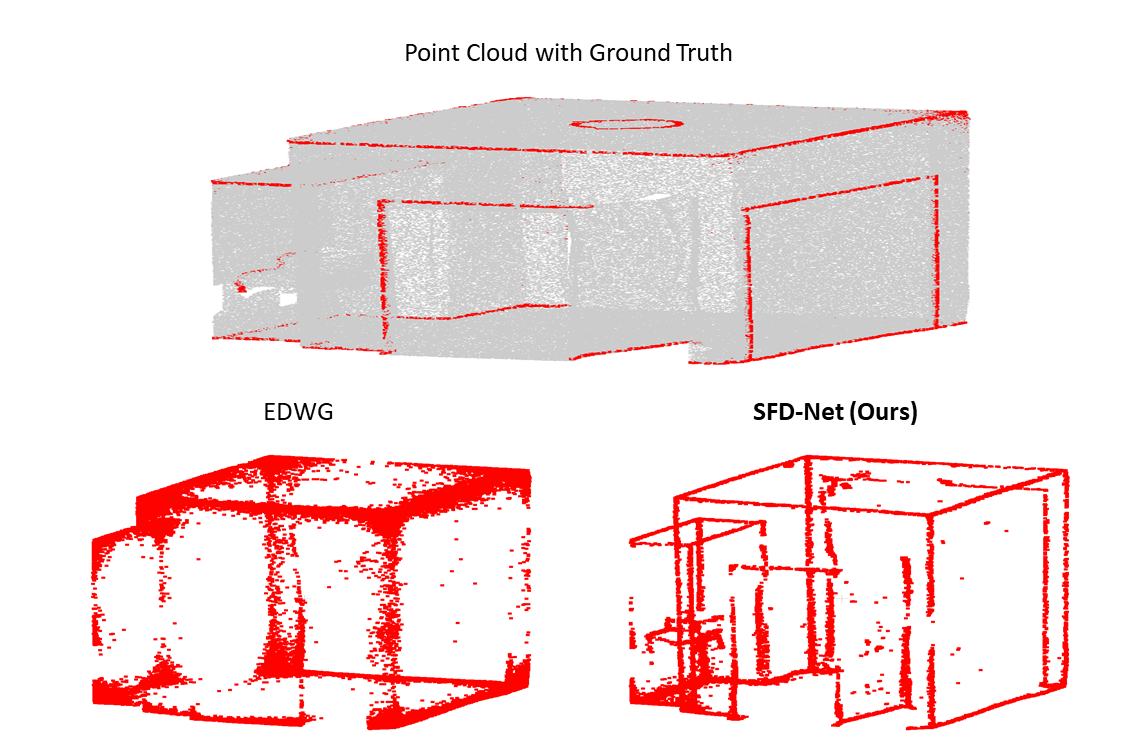
A real hallway, orbited. SFD-Net's zero-shot prediction on S3DIS Area_1 hallway_4 (20K-point subsample), trained only on synthetic CAD.Real S3DIS room. EDWG floods flat surfaces with false positives; SFD-Net recovers clean wall, partition, and furniture edges.
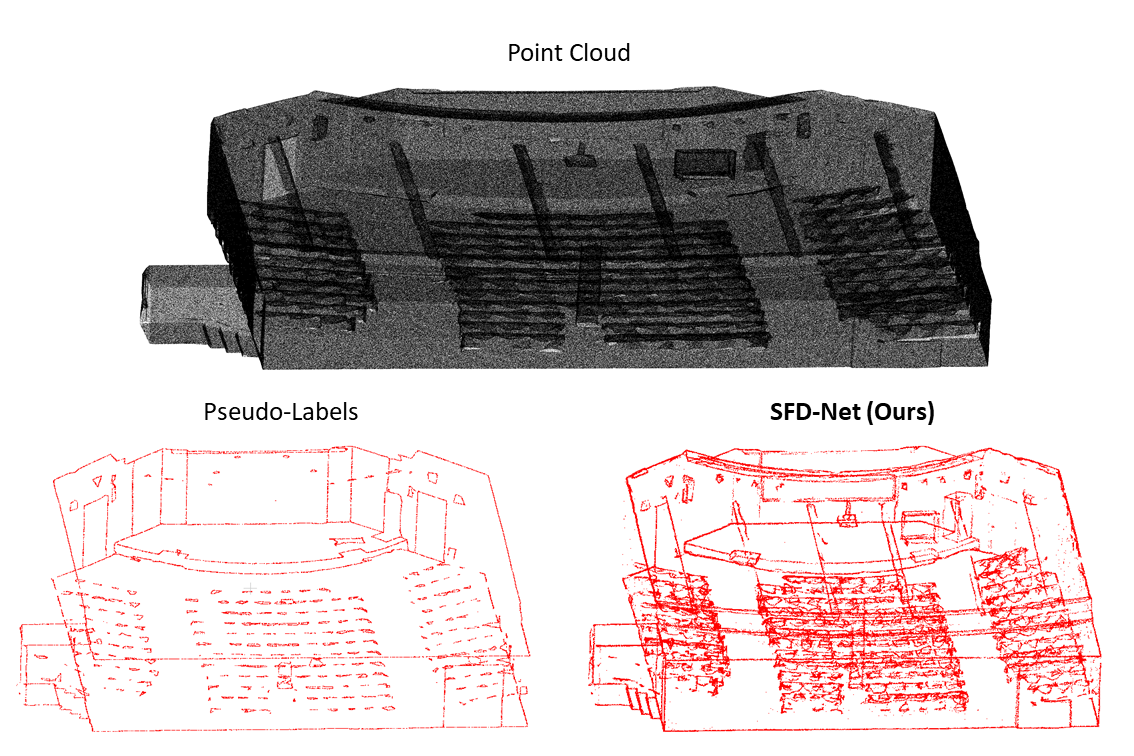
Zero-shot on a 7.1M-point auditorium (~710× the training scale.) No point-wise sharp-feature labels exist for real scans, so semantic-boundary pseudo-labels (left) capture only coarse room edges; SFD-Net (right) also recovers the tiered-seat and platform geometry that the pseudo-label metric cannot credit.
Video
The 44-second version
Problem, descriptor, detection, and robustness — narrated by captions, on a single representative model.
Citation
BibTeX
Placeholder — to be replaced with the official ECCV 2026 entry once released.
@inproceedings{oh2026sfdnet,
  title     = {SFD-Net: Sharp Feature Detection Network Based on Local Geometric Features},
  author    = {Oh, Inyoung and Ko, Kwang Hee},
  booktitle = {Proceedings of the European Conference on Computer Vision (ECCV)},
  year      = {2026}
}